Reviewing Watercolor Christmas Pink Boy Clipart
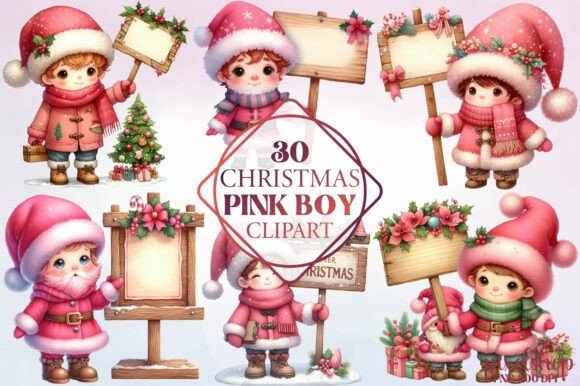
As a designer who spends more time staring at stitch simulations than I care to admit, I have learned that not every pretty image translates well into thread. We often get swept up in the visual appeal of digital assets, forgetting that embroidery is a tactile medium with physical limitations. Recently, I pulled Watercolor Christmas Pink Boy Clipart into my workflow to evaluate its potential for a holiday client project. This was not just a casual browse; it was a stress test to see if this specific illustration could hold up under the needle.
The first impression of this design is undeniably charming. The watercolor aesthetic brings a softness that is rare in standard vector clip art. For those of us creating Illustrations for seasonal collections, the muted pink tones against traditional Christmas motifs offer a refreshing departure from the usual red and green saturation. However, charm does not always equal stitchability. My initial concern was how the subtle gradients and soft edges of the watercolor style would interpret into distinct stitch paths. Would it look muddy, or would it retain its delicate character?
Translating Soft Edges into Stitch Reality
When working with a machine embroidery design that mimics watercolor, the challenge lies in the transition between colors. In digital printing, these blends are seamless. In embroidery, they are achieved through layering thread colors and managing stitch density. I found that this particular clipart requires a thoughtful approach to thread selection. If you attempt to replicate every subtle shade shift, you risk creating a dense, stiff patch that lacks drape. Instead, I recommend simplifying the color palette. Choose three to four dominant thread colors that capture the essence of the pink hues and the Christmas elements, rather than trying to match every pixel of the original digital embroidery file.
The layout of the boy figure is compact, which makes it versatile but also demanding. For a sweatshirt embroidery project, this size works beautifully on the left chest or as a small center graphic. The proportions are balanced, ensuring that the head and body details remain recognizable even when scaled down. However, if you are planning to use this for baby embroidery on onesies, you must be cautious. Tiny details can get lost in the nap of fleece or terry cloth. In such cases, increasing the scale slightly or opting for a simpler running stitch outline rather than complex fill stitch areas can preserve clarity.
Real-World Application: The Holiday Tote Test
To truly gauge the value of this asset, I simulated a real-life scenario: creating a set of custom holiday gift bags. I envisioned using the Watercolor Christmas Pink Boy Clipart on canvas tote bag design prototypes. Canvas is a forgiving fabric, providing a stable base for the stitches. The result was promising. The pink tones popped nicely against natural beige canvas, creating a modern, boutique feel that appeals to contemporary shoppers.
This experience highlighted the importance of contrast. While the watercolor style is soft, embroidery needs definition. I noticed that without proper digitizing adjustments, the lighter pink areas could blend too much with the fabric if the thread sheen was too low. Using a high-sheen rayon or polyester thread helped lift the design off the fabric, giving it the dimensional quality customers expect from a handmade product. This is a crucial insight for any Etsy seller or small shop product creator. Your customers are buying the perceived quality, and crisp, well-defined stitching signals professionalism.
Navigating Fabric and Hoop Constraints
Not every surface is as cooperative as canvas. When considering this design for custom apparel like t-shirts or stretchy knits, stabilization becomes non-negotiable. The watercolor effect relies on smooth color transitions, which can distort if the fabric shifts during stitching. A cut-away stabilizer is essential here to maintain the integrity of the embroidery project. Furthermore, if you are applying this to dark fabrics, you must account for underlay stitches. The pink hues may appear dull if stitched directly over black or navy without a white underlay to brighten the top threads.
Curved surfaces present another hurdle. I would hesitate to use this detailed clipart on a structured cap unless the design was significantly simplified. The curvature of a cap panel can distort the aspect ratio of the boy’s face, potentially making the features look stretched or compressed. For embroidered patch creation, however, it is an excellent candidate. Patches allow for dense stitching on a stable backing, which can then be applied to various garments. This adds versatility to your design assets, allowing you to sell the patch as a standalone item or apply it to jackets and bags post-production.
Commercial Viability and Brand Consistency
From a business perspective, incorporating Watercolor Christmas Pink Boy Clipart into your lineup can diversify your holiday offerings. It appeals to a demographic looking for softer, gender-neutral, or specifically feminine holiday decor. This is particularly relevant for personalized gift markets where buyers seek unique alternatives to mass-produced items. Whether you are creating holiday embroidery for pillow covers, kitchen towels, or nursery decor, this design fits seamlessly into a "modern rustic" or "soft vintage" brand aesthetic.
However, before listing any finished product, you must verify the licensing terms of the original illustration. Just because a file is available for download does not automatically grant commercial rights for physical goods. Always confirm whether the license covers commercial embroidery sales. Additionally, check if the provider offers different file formats. A high-resolution PNG might be great for printable mockup creation for your online store, but you will need a properly digitized embroidery file (such as PES, DST, or EXP) for actual production. Never assume a standard image file is ready for the machine.
Practical Designer Notes for Best Results
To ensure success with this design, I recommend a few final checks before committing to full production. First, always stitch out a test sample on scrap fabric identical to your final material. This allows you to adjust tension and density without ruining good stock. Second, view your design in black and white on your screen. If the details disappear in grayscale, they will likely get lost in thread. This helps identify areas that may need simplified stitching or increased contrast.
- Check Thread Contrast: Ensure the pink shades distinguish themselves from each other and the background fabric.
- Review Stitch Density: Lower density for softer fabrics to prevent puckering; increase for sturdy materials like denim or canvas.
- Confirm Hoop Size: Make sure the design fits comfortably within your hoop with adequate margin for stabilization.
- Inspect Small Details: Zoom in on the eyes and facial features. These may need manual cleanup in your digitizing software to ensure they stitch cleanly.
- Test Stabilizers: Match the stabilizer weight to the fabric weight. Lightweight fabrics need more support.
In conclusion, Watercolor Christmas Pink Boy Clipart is a strong contender for holiday collections, provided it is approached with technical precision. It offers a unique visual personality that stands out in a crowded market of traditional Christmas designs. By respecting the limitations of the medium and preparing your files correctly, you can transform this digital illustration into a high-value embroidery file that enhances your brand and delights your customers. It is not just about putting a picture on fabric; it is about translating emotion into texture.